







Medicine has long relied on what can be seen, measured, and imaged in still frames. Yet many diseases begin long before visible structural damage occurs. Seeing What Others Can’t: How Micro-Vibration Analysis Is Transforming Clinical Diagnosis captures a shift toward detecting disease at its functional origin, where motion, vibration, and timing reveal early pathology.
Micro-vibration analysis focuses on signals the human eye and traditional imaging cannot detect. These microscopic movements carry diagnostic information that enables earlier, more precise clinical decisions. Understanding this shift matters for clinicians, researchers, and healthcare innovators.
Why Traditional Diagnostics Miss Early Disease
Most diagnostic tools focus on structure. Imaging modalities such as MRI, CT, and ultrasound capture anatomy at rest. These tools excel at identifying advanced disease but struggle with early dysfunction.
Early disease manifests as changes in movement quality, vibration patterns, and timing. When diagnostics ignore these signals, pathology progresses unnoticed. This delay limits treatment options and worsens outcomes.
What Is Micro-Vibration Analysis
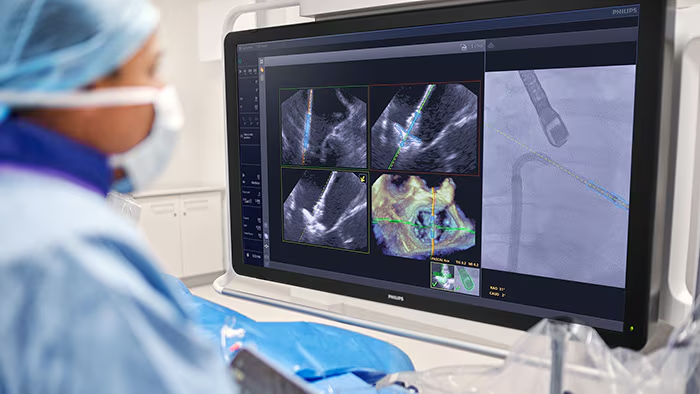
Micro-vibration analysis measures extremely small movements produced by physiological processes. These vibrations occur during breathing, cardiac activity, neuromuscular control, and cellular motion. Though imperceptible, they are measurable with modern sensors.
By analyzing frequency, amplitude, and consistency, clinicians gain insight into functional integrity. This data reflects how systems perform, not just how they look.
The Biology Behind Micro-Vibrations
Living systems are dynamic. Muscles oscillate, tissues resonate, and organs produce rhythmic motion. Health depends on coordinated, stable vibration patterns.
Disease disrupts these patterns. Inflammation, degeneration, or neural impairment introduces irregularity. Micro-vibration analysis detects these disruptions long before structural damage appears.
Why Early Disease Is a Motion Problem
Early pathology rarely causes visible lesions. Instead, it alters control systems and mechanical properties. Subtle tremors, stiffness changes, or delayed responses signal dysfunction.
For example, neurological disorders begin with microscopic tremor changes. Cardiovascular disease alters vascular vibration profiles. These changes precede symptoms and imaging findings.
How Micro-Vibration Analysis Works Clinically
Advanced sensors capture vibration data from the body without physical contact. Optical systems, accelerometers, and laser-based tools record motion at high resolution. Data is collected over time to capture variability.
Algorithms then process the signals, filtering noise and identifying clinically relevant features. The result is a functional diagnostic profile rather than a static image.
The Role of Artificial Intelligence
Micro-vibration data is complex and multidimensional. Artificial intelligence and machine learning are essential for interpretation. Models identify patterns that correlate with disease states.
AI enables comparison against healthy baselines and longitudinal tracking. This transforms raw vibration signals into actionable diagnostic insights clinicians can trust.
Key Clinical Applications Emerging Today
Micro-vibration analysis is gaining traction across multiple specialties. In neurology, it supports early detection of Parkinsonian disorders. In cardiology, it reveals subtle myocardial dysfunction.
Pulmonology uses vibration patterns to assess airway resistance. Otolaryngology analyzes vocal fold micro-vibrations for early neurological or structural pathology.
Advantages Over Conventional Diagnostics
Micro-vibration analysis is non-invasive, radiation-free, and repeatable. Patients are assessed in natural states rather than immobilized positions. This improves ecological validity.
The technology supports frequent monitoring without added risk. Clinicians can track progression or response to therapy in real time.
Why Static Imaging Alone Is No Longer Enough
Static imaging answers whether damage exists. Micro-vibration analysis answers whether systems are functioning optimally. These approaches address different diagnostic questions.
Relying solely on structure delays care. Combining structural and functional diagnostics creates a more complete clinical picture.
Micro-Vibration Analysis and Preventive Medicine
Preventive care depends on early signal detection. Micro-vibration analysis identifies risk before symptoms appear. This enables lifestyle intervention, therapy adjustment, or closer monitoring.
Healthcare systems benefit from reduced downstream costs. Patients benefit from preserved quality of life.
Challenges in Clinical Adoption
Despite promise, barriers remain. Clinicians must learn to interpret new data types. Regulatory pathways require rigorous validation. Integration with electronic health records is ongoing.
However, these challenges mirror those faced by imaging technologies in their early adoption phases. Progress is steady and accelerating.
Regulatory and Research Momentum
Academic research validating micro-vibration biomarkers is expanding rapidly. Regulatory agencies are increasingly open to functional endpoints. Pilot programs demonstrate reproducibility and clinical relevance.
Investment trends show confidence in vibration-based diagnostics. Partnerships between startups, hospitals, and research institutions continue to grow.
Impact on Precision Medicine
Precision medicine requires individualized data. Micro-vibration profiles are unique to each patient. This supports tailored interventions based on functional status rather than population averages.
Longitudinal vibration tracking reveals subtle trends. These insights refine diagnosis and optimize treatment timing.
Ethical and Patient-Centered Considerations
Non-contact diagnostics respect patient comfort and autonomy. Reduced exposure and faster assessments improve patient experience. Transparent communication about functional findings builds trust.
Patients gain clearer explanations for symptoms that imaging cannot explain. This validation strengthens clinician-patient relationships.
Future Directions in Diagnostic Care
As sensors improve and AI models mature, micro-vibration analysis will expand into routine screening. Wearable and remote systems will extend diagnostics beyond clinical settings.
Healthcare will increasingly observe health in motion. This shift aligns diagnostics with biological reality.
Why This Transformation Matters Now
Rising chronic disease rates demand earlier detection. Aging populations require gentler diagnostics. Micro-vibration analysis addresses both needs.
Seeing What Others Can’t: How Micro-Vibration Analysis Is Transforming Clinical Diagnosis reflects a necessary evolution. Medicine is learning to listen to the body’s quietest signals.
Frequently Asked Questions
What is micro-vibration analysis in medicine?
Micro-vibration analysis measures tiny physiological movements to assess functional health before structural damage occurs.
How is micro-vibration analysis different from imaging?
Imaging captures anatomy at rest, while micro-vibration analysis evaluates motion, timing, and functional performance.
Is micro-vibration analysis safe for patients?
Yes. It is non-invasive, non-contact, and does not use radiation or contrast agents.
What diseases can micro-vibration analysis detect early?
Neurological, cardiovascular, respiratory, and musculoskeletal disorders show early vibration changes.
Will micro-vibration analysis replace imaging?
It complements imaging by adding functional insight, creating a more complete diagnostic approach.