







Modern healthcare has mastered the art of seeing structure. Scans reveal organs, bones, and tissues with remarkable clarity. Yet disease rarely begins as a visible defect. From Structure to Function: The Future of AI-Powered Motion Medicine reflects a shift toward understanding health through movement, timing, and dynamic behavior rather than static anatomy alone.
AI-powered motion medicine focuses on how the body performs in real time. Subtle changes in motion often signal dysfunction years before structural damage appears. This emerging approach is reshaping diagnosis, monitoring, and prevention across clinical disciplines.
Why Structure-Centered Medicine Falls Short
Traditional diagnostics prioritize anatomy. Imaging modalities like MRI, CT, and ultrasound capture organs at rest. These tools excel at detecting advanced pathology but struggle to identify early disease.
Early dysfunction alters coordination, elasticity, and timing rather than shape. When diagnostics ignore these changes, disease progresses silently. This gap delays intervention and limits preventive care.
The Shift From Anatomy to Function
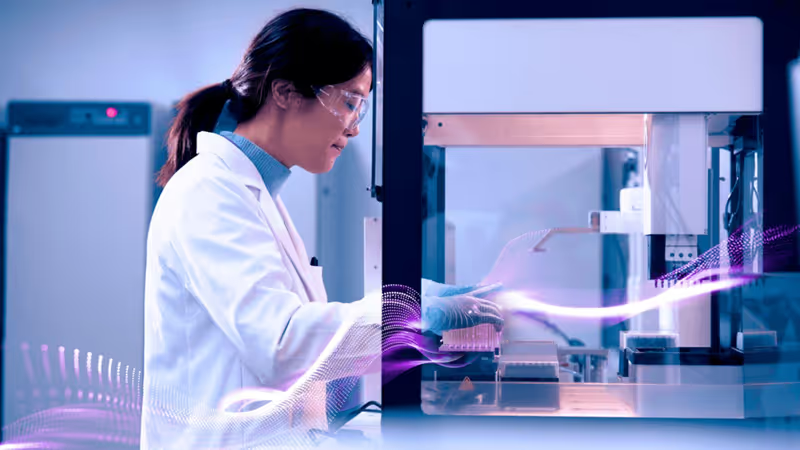
Function defines health. The heart must contract efficiently, lungs must expand rhythmically, and muscles must coordinate precisely. When function degrades, structure often appears normal at first.
Motion medicine captures how systems behave under natural conditions. This functional perspective aligns diagnostics with biological reality rather than static snapshots.
What Is Motion Medicine
Motion medicine is a clinical approach that measures movement, vibration, and temporal patterns to assess health. It evaluates how the body performs instead of how it looks.
Data is collected through sensors that detect micro-movements produced by physiological processes. These signals reflect neuromuscular control, tissue elasticity, and system coordination.
The Role of AI in Motion Medicine
Motion data is dense and complex. Artificial intelligence enables meaningful interpretation by identifying patterns within large datasets. Machine learning models distinguish healthy variability from pathological change.
AI-powered analysis transforms raw motion signals into clinically actionable biomarkers. This allows clinicians to detect dysfunction earlier and with greater precision.
Why Motion Reveals Disease Earlier
Disease disrupts regulation before it damages structure. Inflammation alters tissue stiffness. Neurological decline affects timing and coordination. Cardiovascular disease changes pulse dynamics.
These changes manifest as altered motion patterns. Detecting them early creates opportunities for intervention before irreversible damage occurs.
Key Technologies Enabling Motion Medicine
Several technologies drive this field forward. Optical motion capture, vibrometry, accelerometry, and high-speed sensing record subtle physiological movement. Non-contact systems reduce patient burden.
Cloud-based AI platforms process data rapidly. This enables real-time or near-real-time clinical feedback without invasive procedures.
Clinical Applications Gaining Momentum
Motion medicine is expanding across specialties. Neurology uses gait and tremor analysis to identify early neurodegenerative disease. Cardiology analyzes mechanical heart vibrations to detect dysfunction.
Pulmonology evaluates chest wall motion to assess respiratory efficiency. Orthopedics monitors joint kinematics to guide rehabilitation and injury prevention.
Advantages Over Traditional Diagnostics
Motion-based diagnostics are non-invasive, repeatable, and radiation-free. Patients remain in natural postures, preserving authentic physiological signals.
Frequent monitoring becomes feasible. Clinicians track progression, recovery, or treatment response over time rather than relying on isolated exams.
AI-Powered Motion Medicine and Preventive Care
Preventive medicine depends on identifying risk early. Motion medicine detects functional decline before symptoms appear. This supports lifestyle modification, targeted therapy, or closer surveillance.
Health systems benefit from reduced downstream costs. Patients benefit from prolonged functional independence.
From Population Averages to Personal Baselines
Traditional diagnostics rely on population norms. Motion medicine emphasizes individual baselines. Each patient’s movement signature becomes their reference point.
AI models track deviation from personal norms. This approach improves sensitivity and supports truly personalized care.
Challenges in Adoption and Integration
Despite promise, adoption requires change. Clinicians must learn to interpret functional metrics. Validation and regulatory approval demand rigorous evidence.
Integration with electronic health records and clinical workflows is ongoing. These challenges are transitional, not prohibitive.
Regulatory and Research Progress
Research supporting motion-based biomarkers is growing rapidly. Clinical trials demonstrate reproducibility and correlation with outcomes. Regulatory bodies are increasingly open to functional endpoints.
Investment trends indicate confidence in AI-powered motion medicine. Collaboration between academia, startups, and healthcare systems accelerates progress.
Ethical and Patient Experience Considerations
Non-contact diagnostics respect patient comfort and safety. Reduced exposure and faster assessments improve accessibility. Clear explanation of functional findings builds trust.
Patients gain validation for symptoms that imaging cannot explain. This strengthens clinician-patient relationships and engagement.
Implications for Precision Medicine
Precision medicine requires granular, individualized data. Motion medicine provides continuous insight into how each patient functions over time.
This data enables tailored treatment plans, optimized timing, and better outcome prediction. AI enhances scalability without sacrificing personalization.
The Future Clinical Workflow
Future clinics will combine structure and function seamlessly. Imaging will confirm anatomy. Motion analysis will reveal performance.
AI-powered dashboards will summarize trends and risks. Clinicians will intervene earlier, guided by dynamic data rather than delayed damage.
Why This Evolution Matters Now
Chronic disease prevalence is rising. Aging populations demand gentler diagnostics. Healthcare systems need earlier, cost-effective solutions.
From Structure to Function: The Future of AI-Powered Motion Medicine represents a necessary evolution. Medicine is learning to measure what truly matters.
Frequently Asked Questions
What is AI-powered motion medicine?
AI-powered motion medicine analyzes movement and vibration data using artificial intelligence to assess functional health.
How is motion medicine different from imaging?
Imaging captures anatomy at rest, while motion medicine evaluates dynamic performance over time.
Is motion medicine safe for patients?
Yes. Most systems are non-contact, non-invasive, and free from radiation.
What conditions benefit most from motion medicine?
Neurological, cardiovascular, respiratory, and musculoskeletal conditions show early functional changes detectable through motion analysis.
Will motion medicine replace traditional diagnostics?
It complements existing tools by adding functional insight, enabling earlier and more precise clinical decisions.